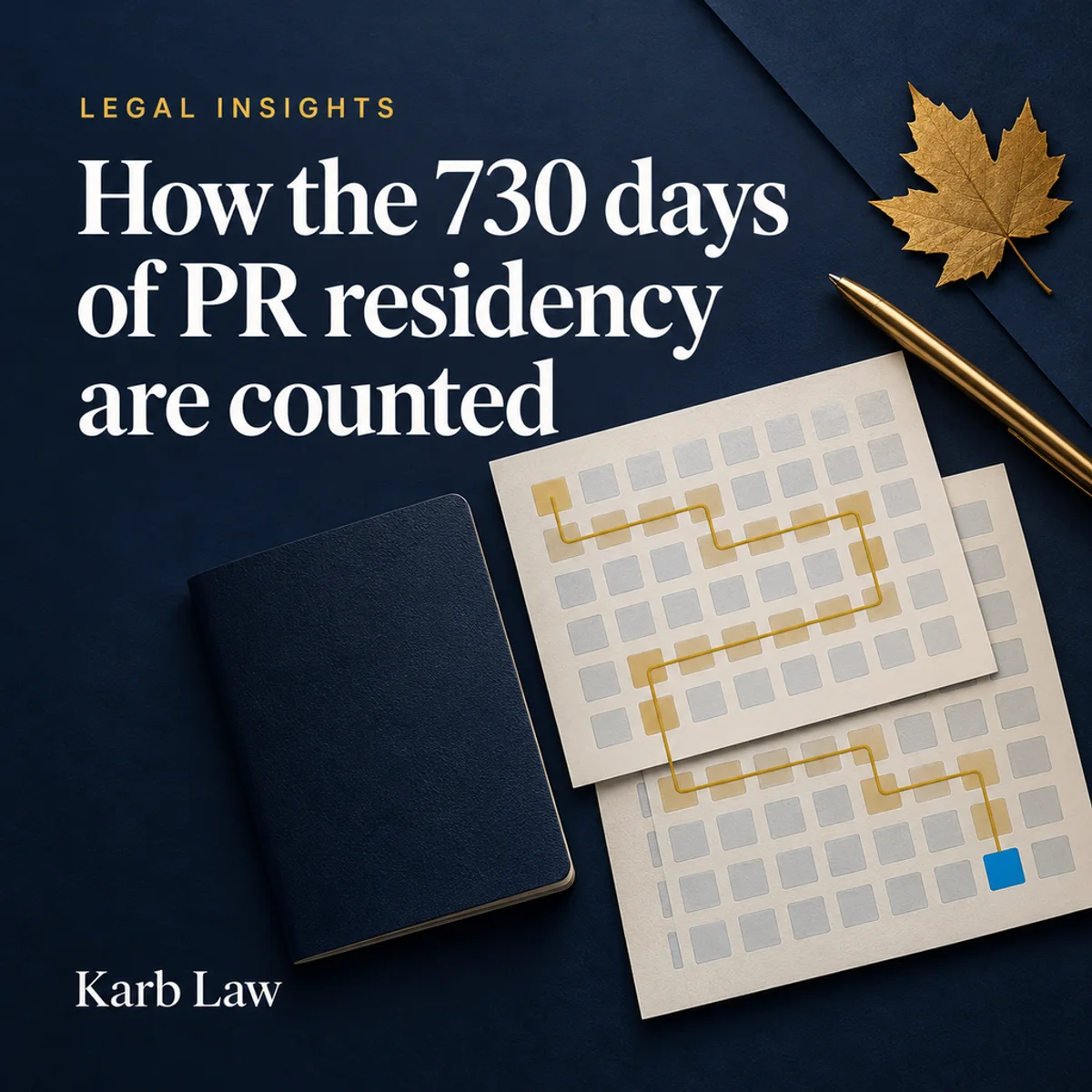
A permanent resident meets the residency obligation by having at least 730 qualifying days in a five-year period. A qualifying day is a day in Canada or a day abroad that falls under one of the routes in section 28 of the Immigration and Refugee Protection Act (IRPA). The days do not have to be in a row. Under IRCC's own instructions to officers, the day someone leaves Canada and the day they come back both count as days in Canada, and a trip out and back on the same day is not an absence at all.
The harder part is knowing which five years are counted and which days abroad still count. Both depend on facts that an officer checks against documents, so the rules below are set out the way the Act, the Regulations and IRCC's program instructions put them.
Which five years does the officer look at?
It depends on how long the person has held permanent resident status on the day of the examination. Section 28(2)(b) of IRPA sets two different tests.
Permanent resident for five years or more
Permanent resident for under five years
Because the first window moves forward every day, a count that met the obligation last year can fall short this year without any new trip. Days from the first years after landing drop out of the window once they are more than five years old.
What counts as one day in Canada?
IRCC's program delivery instructions on permanent resident status determination give officers these rules for a trip:
- The day of departure counts as a day in Canada.
- The day of return counts as a day in Canada.
- Leaving Canada and coming back on the same day is not treated as an absence.
So the number of days a trip removes from the count is the number of full days between departure and return. A two-week holiday that leaves on 1 August and comes back on 15 August takes away 13 days, not 15. Over five years of regular travel, that difference adds up.
A sample travel log, counted line by line
The log below is a constructed example, not anyone's file. It belongs to a permanent resident who landed in 2015 and was examined by a border officer on returning to Canada on 2 March 2026. The window is therefore 2 March 2021 to 2 March 2026, which holds 1,826 days. The third column shows how many days of each trip are lost to the count.
| Trip | Left and returned | Days lost | Why |
|---|---|---|---|
| Caring for a parent abroad | 15 Mar 2021 to 15 Mar 2022 | 364 | Physically outside Canada and no route in s. 28(2)(a) applies. Both travel days count as days in Canada. |
| Shopping in Buffalo | 14 May 2022, back the same day | 0 | Out and back on one day is not an absence. |
| Summer with family | 1 Jul 2022 to 30 Sep 2022 | 90 | A holiday abroad. Only the 90 full days in between are lost. |
| Work assignment | 5 Jan 2023 to 4 Jan 2024 | 0 | Employed full-time by a company incorporated in Ontario and assigned full-time to its client in Dubai. The 363 days abroad count under s. 28(2)(a)(iii). |
| Living in Lisbon with a spouse who is a Canadian citizen | 10 Jun 2024 to 10 Jun 2025 | 0 | The couple lived together abroad. The 364 days count under s. 28(2)(a)(ii). |
| Staying on alone after the spouse went home | 1 Aug 2025 to 2 Mar 2026 | 212 | The spouse was in Canada, so the person was not accompanying anyone. The days do not count. |
The example shows where the result is decided. On physical presence alone the count would be 433, well under 730. The two routes abroad add 727 days and take the total to 1,160. That is why officers ask for proof of exactly those two periods: the employment terms and the employer's Canadian status for the assignment, and the spouse's citizenship and the shared address for Lisbon. A day either way at the edges of the window would not change this example, and the officer fixes those edges.
When days outside Canada still count
Section 28(2)(a) of IRPA lists the routes, and section 61 of the Immigration and Refugee Protection Regulations adds the conditions. Each route is a separate test.
- 1. Accompanying a spouse, common-law partner or parent who is a Canadian citizen
- Section 61(4) counts a day as accompanying when the permanent resident ordinarily resides with that person outside Canada. For a parent, the route covers a child, defined in section 61(6) as under 22 and not a spouse or common-law partner.
- 2. Employed full-time outside Canada by a Canadian business or a public service
- Under section 61(3), the employee or contractor has to be assigned full-time, as a term of the employment or contract, to a position outside Canada, to an affiliated enterprise outside Canada, or to a client outside Canada. A Canadian business is a corporation incorporated under federal or provincial law with an ongoing operation in Canada, or an enterprise with an ongoing operation in Canada that is majority-owned by Canadian citizens, permanent residents or Canadian businesses. Section 61(2) excludes a business whose main purpose is to let a permanent resident meet the obligation while living abroad.
- 3. Accompanying a permanent resident spouse, partner or parent who is employed that way
- The person accompanied is a permanent resident rather than a citizen, and their own full-time work abroad meets route 2. Section 61(5) treats the accompanying permanent resident as complying for as long as the person accompanied complies.
- 4. Days in Canada
- Any day of physical presence, using the three day rules above.
A spouse who is a permanent resident but is not working for a Canadian business abroad does not open any route. Days spent living with that spouse outside Canada are counted like any other absence.
Someone who has been a permanent resident for under five years
For a newer permanent resident, the officer starts from the landing date and works forward. Take a constructed example: a person who became a permanent resident on 1 September 2023 and is examined on 30 October 2026, with 200 qualifying days so far.
- The first five-year period ends on the fifth anniversary, 1 September 2028.
- From 30 October 2026 to that date there are about 670 days left.
- The 200 days in hand plus the 670 still to come make about 870 possible days.
- Since 870 is more than 730, the person can still meet the obligation in the first period, which is the question section 28(2)(b)(i) asks.
The same arithmetic with 50 days in hand gives about 720, which is under 730. At that point the obligation can no longer be met inside the first five years, even if the person never leaves Canada again before the anniversary.
Records that support the count
The officer works from what the permanent resident declares and from the records the government already holds. IRCC's application for a PR card asks for every absence in the five-year period, and the officer can compare it with entry and exit data. Papers that help an officer see the same dates include:
- every passport used in the period, including expired ones;
- the person's travel history from the Canada Border Services Agency, which can be requested through an access to information request;
- for route 1, proof of the spouse's or parent's citizenship and of the shared home abroad, such as a lease in both names;
- for route 2, the employment contract or assignment letter, and records showing the employer's incorporation and its operation in Canada.
Our older article on permanent residents and travelling outside Canada covers the PR card and the travel document that a returning resident uses at the border.
If the count falls short
A count under 730 does not end permanent resident status by itself. Under section 28(2)(c), the officer can find that humanitarian and compassionate considerations, including the best interests of a child directly affected, justify keeping the status. IRCC's instructions list factors such as how far the person exceeded three years outside Canada, whether illness or events beyond their control kept them away, and whether they came back at the first opportunity. If the officer decides the obligation was breached, the decision can be appealed to the Immigration Appeal Division. Our article on who can appeal to the Immigration Appeal Division explains which route of appeal applies to a decision made abroad and to a removal order made at a port of entry.
Angelina Shuster is a paralegal licensed by the Law Society of Ontario, and Karb Law represents appellants before the IAD in residency obligation appeals. To have a decision letter or a day count reviewed, the free assessment form is the place to start.
This article is general information about how the residency obligation is applied. It is not legal advice and does not create a paralegal-client relationship.